AIRselect
Air freight
- Export: pick-up, export clearance and booking on suitable flights from German and European airports.
- Import: coordination with our partner at origin, import customs clearance and delivery to your dock.
With AIRselect, SEAselect and our customs clearance, Logselect handles your shipments from enquiry to delivery. Quick to request, transparent to track, with a personal contact.

Each mode of transport has its own product, and customs clearance can be booked with it or on its own. Enquiry, quote, documents and shipment status run digitally in one place.
Air freight
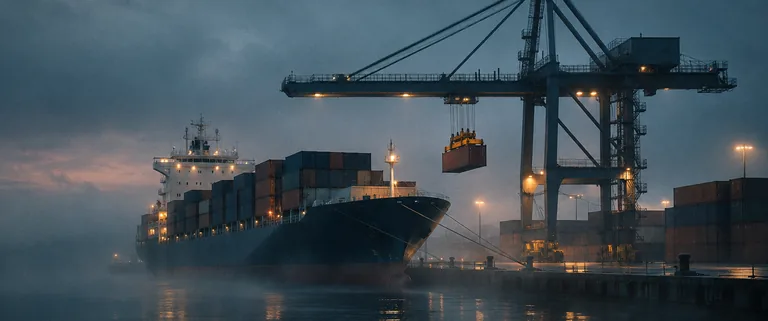
Ocean freight
Import and export clearance
Road transport by truck will follow as the third product.
Enter origin, destination, pieces, dimensions and weight online.
You receive a fixed-price quote with transit time and routing.
Confirm with one click. We book the cargo space and arrange the pick-up.
Check status, air waybill or bill of lading and documents online at any time.
Enter an air waybill number or a container or bill of lading number. We recognise the airline or shipping line, check the number and take you straight to the right tracking page.
The result appears here. Shipments booked with Logselect: we keep you informed of the status personally as well.
In air freight, the higher of gross and volumetric weight is charged. Volumetric weight is length × width × height in cm, divided by 6,000.
In LCL ocean freight, the freight ton (W/M) is charged: cubic metres or metric tons, whichever is higher. 1 m³ equals 1,000 kg, with a minimum of 1 m³.
One line per piece size: number of identical pieces, their dimensions and the weight of one piece. Sample values: two pallets and three cartons.
Choose origin and destination freely and compare the estimated greenhouse gas emissions and typical transit times of the options that are common on this route. The calculation uses average emission factors in line with the GLEC Framework and ISO 14083.
Estimate in CO₂e, well-to-wheel, main carriage only, without pre- and on-carriage. Factors per tonne-kilometre: air freight 800 g, ocean container 14 g, truck 85 g CO₂e, mid-range values within the GLEC defaults. Air: great-circle distance plus 95 km. Sea: shortest route on the Eurostat maritime network via the Suez and Panama Canals; diversions around the Cape of Good Hope significantly increase distance, transit time and emissions. Road: straight-line distance × 1.25. Sea-air is only shown on lanes where it is common, via Dubai, Colombo or Los Angeles. Transit times are indicative: air door to door, sea port to port. For binding figures we calculate your shipment individually.
The price depends on the chargeable weight, the route, the type of goods and the service you need. In air freight the higher of actual and volumetric weight applies, in LCL ocean freight weight or volume, and with FCL the whole container. Our weight calculator shows you in advance which weight will be charged, and you get a binding quote via the enquiry form.
Air freight usually reaches its destination door to door within a few days, depending on the connection and handling. Ocean freight takes roughly two to six weeks port to port, depending on the trade lane. The sea-air combination sits in between. Details are on the AIRselect and SEAselect pages.
Usually a commercial invoice, a packing list with dimensions and weights, and your EORI number. For customs clearance you also need a customs power of attorney, and for dangerous goods the safety data sheet. The customs page shows which documents import and export require.
Yes. We handle import and export clearance, transit procedures, proof of origin and export control and sanctions checks. You can book customs together with transport or on its own; more on the customs page.
Yes, there are dedicated products for this: DANair for dangerous goods, TEMair for temperature-controlled shipments and LIVair for live animals, and in ocean freight DANsea and TEMsea.
Send us the type of goods, dimensions, weight and route via the enquiry form, or give us a call. We check the requirements and send you a quote. Background on common questions is in our guides.
Practical guides on the questions we hear most often, kept up to date with the current rules.
What has applied to the state of charge since 1 January 2026, and which documents you need.
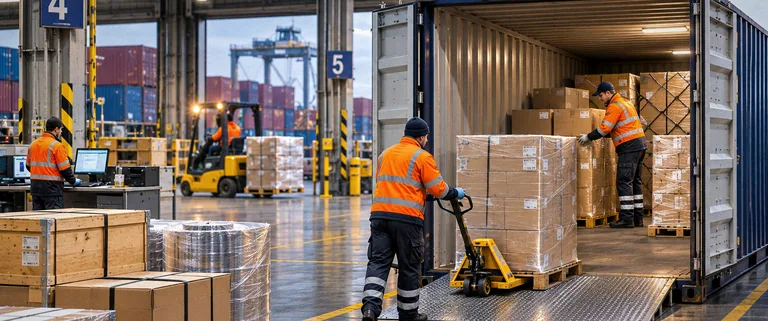
All eleven rules at a glance: who bears costs, risk and customs.
Internal dimensions, volume and payload of ocean containers and air cargo pallets.

Temperature ranges, packaging and GDP obligations for the cold chain.
Flat-rate duty, handling fee and EU customs reform: what has changed.
Send us the key details and we will get back to you with a quote.